

Pickleball-Related Eye Injuries
Pickleball-related eye injuries are on the rise due to the sport’s rapid growth in the United States, especially among adults aged 50 and older
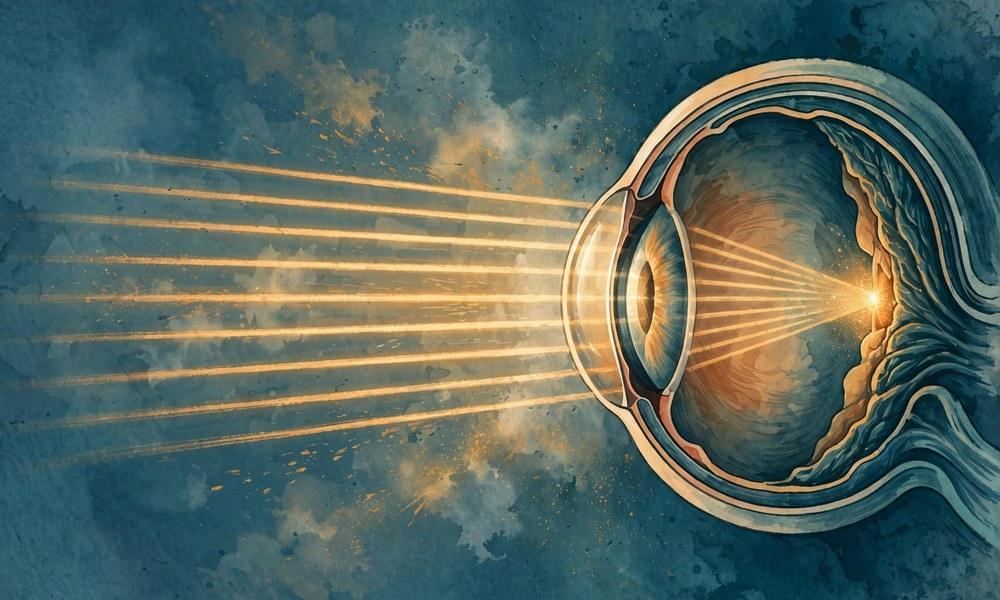
Every so often a patient asks me a question that has nothing to do with glasses and everything to do with life: Doctor, why does vision get cloudy as we get older? Why doesn't it just stay clear?
The honest answer comes from physics, and its name is entropy. Entropy is simply a measure of disorder — how jumbled, scattered, and run-down things have become. The deepest law of nature says that left to itself, everything drifts toward disorder. Rooms get dusty. Gardens go to weeds. And eyes — eyes fog, scatter light, and lose their edge.
Your eye knows this law intimately, and it fights it every minute of your life. Clear vision is order. Almost everything I check in the exam room is, in one way or another, a report on how that fight is going. Let me show you four ways to see it.
The cornea — the clear front window of the eye — stays transparent only because a single layer of cells on its inner surface, the endothelium, pumps water out of it around the clock. The moment those pumps rest, the cornea takes on water and turns hazy, like a windshield with a broken defroster.
Here is the part that humbles me: we are born with a fixed supply of these pump cells, and they do not grow back. We spend them slowly across a lifetime. When too many are lost — to age, disease, or injury — the bailing can't keep up, and the window fogs for good. Your clear cornea this morning is not a given. It is a maintenance achievement, renewed every hour by cells that have been on duty since the day you were born.
Why is a healthy cornea clear at all? Because its collagen fibers are laid out in a strikingly regular lattice — shelf after shelf of fibers in perfect rows, so light slips through in an orderly way instead of bouncing off in every direction.
Scramble that lattice and the same tissue turns cloudy. Order you can see through; disorder you cannot. A cataract tells the same story inside the lens: proteins that spent decades in a precise, transparent arrangement gradually clump and scatter. Nobody's lens "breaks." It simply loses the tidiness of its youth — entropy, collecting its debt one scattered ray at a time.
A perfect eye takes light from a single point in the world and lands it on a single point on the retina — a crisp delivery, every detail intact. Real eyes are imperfect couriers. Tiny optical flaws, called aberrations, smear that point into a soft blob, and information the world sent you never quite arrives.
It is the difference between a letter in sharp print and the same letter left out in the rain: the words are all still there, technically, but good luck reading them. Much of what we do with modern lenses and refractive measurements is an attempt to un-smear that delivery — to give the information back its neat edges.
Vision begins when particles of light — photons — strike the retina. In daylight they arrive in a flood, billions of them, and the picture is smooth and rich. But in dim light they arrive as a drizzle, and a picture built from a drizzle is grainy by necessity.
This is why everyone's night vision has a hard floor, and it isn't a defect. Judging a dark road by a handful of photons is like judging the weather from three raindrops. When patients tell me the world looks washed out and speckled at dusk, often their eyes are healthy — physics is simply rationing the light, and no lens can manufacture photons that never arrived.
Once you start seeing entropy, you see it everywhere in the eye — each structure keeps its own particular kind of tidiness, and each has its own way of falling into disarray:
The lashes stand in orderly rows, a picket fence that sweeps dust and debris away from the surface and triggers the blink before trouble lands. When lashes turn inward (trichiasis) or the row grows unruly, the fence itself starts scratching the window it was posted to guard.
The lids are the windshield wipers — some fifteen thousand blinks a day, each one spreading a fresh, even tear film across the cornea and ushering the old film away. The lids' oil glands keep that film from evaporating, and when those glands clog with age, the film breaks up, the surface dries in patches, and vision fluctuates blink to blink. A wiper with a worn blade still moves; it just leaves the glass streaked.
The iris is the aperture — a living diaphragm that sizes the pupil moment by moment, rationing how much light gets in: wide in the dark to catch every photon it can, narrow in bright sun to protect the optics from glare. Order at the gate. When the iris is damaged or its reactions falter, the rationing fails — too much light, too little, at all the wrong moments.
The retina is where order becomes information. Its photoreceptors stand in a precise mosaic, a hundred million rods and cones in their assigned places, each reporting on its own small patch of the world. In macular degeneration that mosaic breaks up at its very center — tiles missing from the middle of the floor — and no lens on Earth can restore a picture whose sensors have gone missing. That is entropy at the last station: not light lost on the way in, but the receivers themselves in disarray.
So when a patient asks why vision doesn't just stay clear, I think of the eye as a small, tireless housekeeper working against a universe that loves a mess. The pumps bail. The lattice holds its rows. The optics deliver the mail as neatly as they can. For decades, usually, the housekeeper wins — and every clear morning you have ever opened your eyes to is the proof.
My job, as I see it, is to check on the housekeeper: count the pump cells, watch the lattice, measure the smear, and catch the disorder early, while it can still be tidied. That is most of what preventive eye care is — housekeeping, done on time.
— Paddy Kalish, OD


