

Pickleball-Related Eye Injuries
Pickleball-related eye injuries are on the rise due to the sport’s rapid growth in the United States, especially among adults aged 50 and older
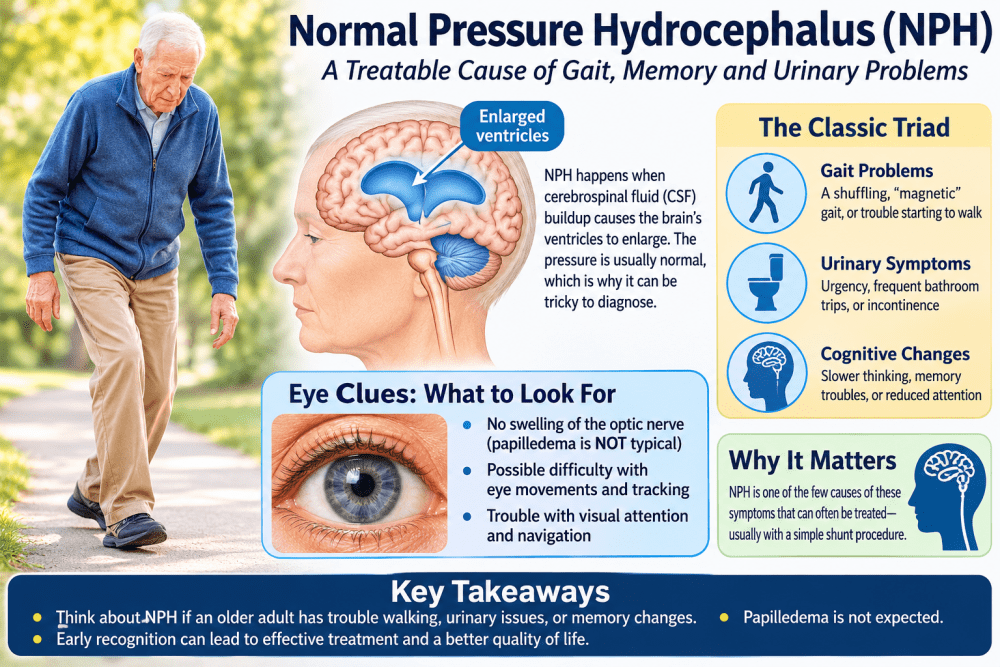
Have you noticed an older family member beginning to shuffle when walking, having difficulty remembering things, or suddenly needing to use the bathroom more frequently?
Many people assume these changes are simply part of getting older. Others may suspect Parkinson's disease or Alzheimer's disease.
But there is another possibility that deserves attention: Normal Pressure Hydrocephalus (NPH).
NPH is a condition involving the buildup and abnormal circulation of cerebrospinal fluid (CSF), the clear fluid that surrounds and protects the brain and spinal cord.
As this fluid accumulates, the brain's internal fluid-filled spaces, called ventricles, become enlarged. This enlargement can affect nearby brain pathways responsible for walking, bladder control, and thinking.
Interestingly, despite the enlarged ventricles, the measured pressure of the spinal fluid is often within the normal range. That is where the name comes from.
Doctors often describe NPH by three characteristic symptoms.
1. Changes in Walking
This is frequently the earliest and most noticeable symptom.
Patients may:
Walk with short, shuffling steps.
Have difficulty lifting their feet.
Feel as though their feet are stuck to the floor.
Have trouble starting to walk or turning around.
Become increasingly unsteady and experience falls.
This unusual walking pattern is sometimes called a "magnetic gait."
2. Bladder Problems
As the condition progresses, patients may develop:
Frequent urination.
Sudden urgency to use the bathroom.
Difficulty holding urine.
Urinary accidents or incontinence.
These symptoms can easily be mistaken for ordinary bladder problems associated with aging.
3. Changes in Memory and Thinking
NPH can also affect the way the brain processes information.
Patients may experience:
Slower thinking.
Difficulty concentrating.
Forgetfulness.
Trouble organizing everyday activities.
Reduced attention and mental flexibility.
Unlike typical Alzheimer's disease, some cognitive difficulties in NPH involve slowed thinking and impaired executive function rather than memory loss alone.
This is particularly interesting because the eyes can provide clues about neurological health.
Although NPH is primarily a brain disorder, there are several visual and eye-movement functions worth evaluating.
Papilledema: Is the Optic Nerve Swollen?
Papilledema is swelling of the optic nerve head, usually caused by increased pressure inside the skull.
An important distinction: papilledema is NOT typically expected in uncomplicated Normal Pressure Hydrocephalus.
In fact, the absence of papilledema is consistent with the usual presentation of NPH.
If an eye examination reveals true papilledema, additional investigation is necessary to rule out another cause of increased intracranial pressure.
Eye Movement Problems
Emerging research suggests that some people with NPH may have difficulty with certain eye movements.
These can include:
Slower initiation of eye movements when shifting from one object to another.
Difficulty tracking moving objects.
Problems coordinating visual attention.
Difficulty shifting attention between different objects or surroundings.
Researchers have also found that certain eye-movement measurements may be associated with cognitive changes.
These findings are promising, although eye-movement abnormalities are not currently established diagnostic criteria for NPH.
Visual Attention and Navigation
Some patients may also have difficulty processing visual information efficiently.
For example, they may struggle to navigate crowded environments, locate objects, or coordinate what they see with their movements.
These symptoms are not specific to NPH, but they reinforce the importance of considering neurological causes when evaluating unexplained visual-motor difficulties.
Diagnosis usually involves a combination of neurological examination and brain imaging.
An MRI or CT scan may demonstrate enlarged ventricles.
Doctors may also perform a procedure called a lumbar puncture, sometimes referred to as a spinal tap. During this procedure, a quantity of cerebrospinal fluid is removed.
Doctors then evaluate whether walking and other symptoms improve.
This is called a CSF tap test and can help determine whether a patient might benefit from treatment.
One of the most important things to understand about NPH is that it is potentially reversible.
The most common treatment is a surgical procedure called a ventriculoperitoneal (VP) shunt.
A small tube is placed to redirect excess cerebrospinal fluid from the brain into the abdominal cavity, where the body can absorb it.
Many patients experience meaningful improvement, particularly in walking and balance. Cognitive and bladder symptoms may also improve, although results vary.
Early diagnosis and treatment can make a significant difference.
As an Optometric Physician, I believe it is important to recognize that not every problem involving vision, balance, or visual coordination originates within the eyes themselves.
A comprehensive eye examination can sometimes reveal clues suggesting an underlying neurological problem.
Changes in eye movements, pupil responses, visual function, and optic nerve appearance may help identify patients who need further neurological evaluation.
The Take-Home Message
If you or someone you know develops unexplained walking difficulties, urinary urgency or incontinence, and changes in thinking or memory, don't automatically assume these are simply consequences of aging.
Normal Pressure Hydrocephalus is an important possibility to discuss with a physician.
Recognizing the condition early may open the door to treatment and a better quality of life.
Paddy Kalish, OD
Optometric Physician
This article is for educational purposes and is not a substitute for professional medical evaluation.


