

Pickleball-Related Eye Injuries
Pickleball-related eye injuries are on the rise due to the sport’s rapid growth in the United States, especially among adults aged 50 and older
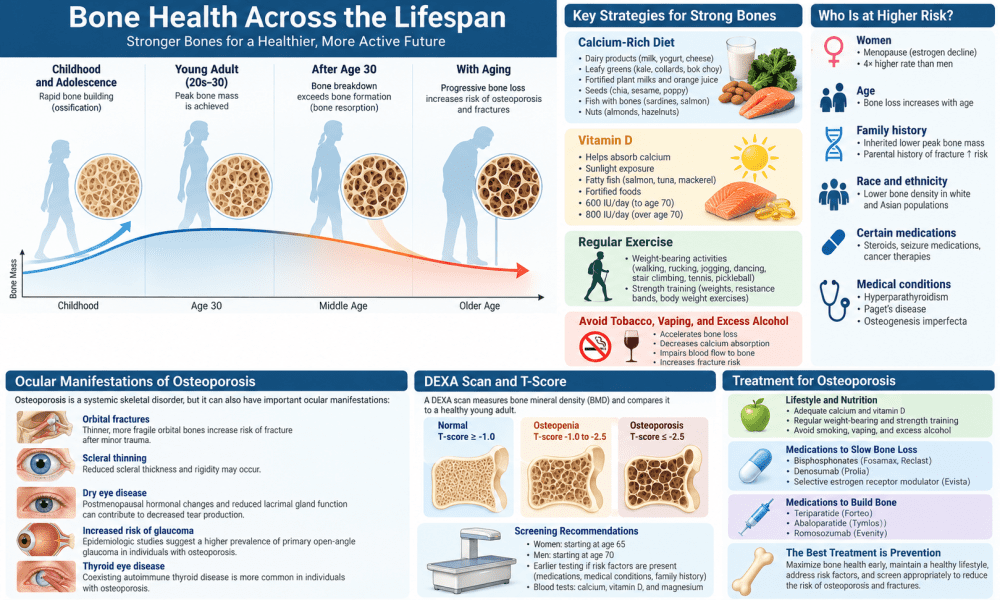
An educational article exploring bone development, osteoporosis prevention, and the often-overlooked relationship between skeletal health, vision, and ocular disease.
Bone health is an essential component of lifelong wellness. Although osteoporosis is commonly associated with aging, the foundation for strong bones is established much earlier in life. What many people do not realize is that certain disorders affecting bone metabolism can also have important consequences for the eyes, orbit, and visual system.
Maintaining healthy bones requires adequate nutrition, physical activity, hormonal balance, and appropriate medical screening. Understanding these factors can help reduce the risk of fractures, preserve mobility, and identify systemic conditions that may affect vision.
Bone is living tissue that undergoes continuous remodeling. Two specialized cell types regulate this process: osteoblasts, which form new bone, and osteoclasts, which break down existing bone.
During childhood and adolescence, bone formation generally exceeds bone resorption. Most individuals achieve peak bone mass during their twenties or early thirties.
After peak bone mass is reached, bone remodeling continues, but bone loss may gradually exceed bone formation. The rate of loss varies considerably and is influenced by genetics, hormonal changes, nutrition, physical activity, medications, and underlying medical conditions.
When bone density and structural integrity decline sufficiently, osteoporosis may develop. This condition increases susceptibility to fractures, particularly involving the hip, vertebral column, and wrist.
Osteoporosis is frequently called a silent disease because significant skeletal deterioration may occur without noticeable symptoms until a fracture develops.
Calcium is essential for skeletal mineralization, muscle contraction, nerve transmission, and numerous cellular processes.
Dietary sources include dairy products, calcium-fortified plant beverages, kale, collard greens, bok choy, almonds, sesame seeds, and canned sardines or salmon containing edible bones.
Although spinach contains calcium, its high oxalate concentration substantially reduces calcium absorption.
Recommended daily calcium intake varies with age and sex:
|
Population |
Daily calcium |
|---|---|
|
Adults 19–50 |
1,000 mg |
|
Men 51–70 |
1,000 mg |
|
Women 51–70 |
1,200 mg |
|
Adults 71 and older |
1,200 mg |
Dietary calcium is generally preferable to supplementation when nutritional requirements can be met through food. Supplements may be appropriate when dietary intake is inadequate.
Vitamin D promotes intestinal calcium absorption and supports normal skeletal mineralization.
Sources include fatty fish, fortified foods, and vitamin D produced in the skin following ultraviolet exposure.
The recommended dietary allowance is generally 600 IU daily for adults through age 70 and 800 IU daily thereafter. Individual requirements may differ.
Because ultraviolet radiation also increases the risk of cataracts, eyelid malignancies, and other ocular damage, intentional unprotected sun exposure is not recommended as a strategy for obtaining vitamin D.
Weight-bearing exercise and resistance training help preserve bone mineral density, muscle strength, coordination, and balance.
Walking, dancing, stair climbing, tennis, and appropriately supervised resistance exercises are useful activities. Strength training also reduces fall risk by improving muscular support and stability.
Individuals with established osteoporosis or vertebral fractures should seek professional guidance before beginning high-impact exercise or activities involving forceful spinal bending or twisting.
Tobacco use contributes to skeletal deterioration through several mechanisms, including impaired osteoblast activity, hormonal changes, reduced blood supply, and interference with normal bone healing.
Smoking is associated with reduced bone mineral density, increased fracture risk, and delayed fracture healing.
Nicotine exposure may adversely affect bone metabolism, although the long-term skeletal consequences of vaping are less thoroughly established than those of cigarette smoking.
Excessive alcohol consumption also increases fracture risk through impaired bone metabolism, nutritional deficiencies, and an increased likelihood of falls.
Smoking has additional implications for ocular health, including increased risks of cataracts, age-related macular degeneration, and thyroid eye disease.
Estrogen and testosterone are important regulators of skeletal remodeling.
Following menopause, declining estrogen levels accelerate bone resorption. This can produce substantial bone loss during the early postmenopausal years.
Men generally develop greater peak bone mass, but they also experience osteoporosis, particularly with advancing age or reduced testosterone levels.
Other contributors include family history, low body weight, nutritional deficiencies, physical inactivity, and certain chronic illnesses.
Although population-level differences in bone density have been observed among racial and ethnic groups, individual fracture risk should be assessed using personal clinical factors rather than ancestry alone.
Several systemic diseases can weaken skeletal tissue, including hyperparathyroidism, hyperthyroidism, malabsorption disorders, chronic kidney disease, and inflammatory diseases.
Osteogenesis imperfecta is an inherited connective tissue disorder characterized by bone fragility and, in some patients, distinctive ocular findings.
Paget disease of bone causes abnormal bone remodeling, potentially producing enlarged, structurally weakened, or deformed bones.
Certain medications may also accelerate bone loss. Important examples include prolonged systemic glucocorticoid therapy, some antiseizure medications, aromatase inhibitors, and androgen-deprivation therapy.
Long-term corticosteroid use deserves particular attention because it can adversely affect both skeletal and ocular health.
Clinical perspective for eyecare providers
Osteoporosis itself does not ordinarily cause a characteristic ocular disorder. However, several conditions associated with abnormal bone metabolism, connective tissue integrity, or osteoporosis treatment can produce clinically significant ophthalmic findings.
Osteogenesis imperfecta is primarily associated with abnormalities of type I collagen.
Because collagen is a major structural component of the sclera, affected individuals may demonstrate unusually thin scleral tissue, allowing the underlying uveal pigmentation to become more visible.
This produces the characteristic blue or blue-gray scleral appearance.
Additional ocular findings may include corneal thinning, reduced corneal rigidity, and increased susceptibility to certain structural abnormalities.
The presence of blue sclera, particularly when accompanied by recurrent fractures, hearing impairment, or a family history of skeletal fragility, should prompt consideration of an underlying connective tissue disorder.
Paget disease can affect cranial bones, including structures surrounding the optic canals and orbit.
Abnormal enlargement of these bones may occasionally compress neural structures, including the optic nerve.
Potential manifestations include progressive visual impairment, optic neuropathy, visual field defects, and, in some cases, cranial nerve dysfunction.
These complications are uncommon but clinically important because delayed recognition of compressive optic neuropathy may result in permanent visual loss.
Systemic corticosteroids are a recognized cause of secondary osteoporosis.
They are also associated with ocular complications, particularly posterior subcapsular cataracts and steroid-induced ocular hypertension or glaucoma.
Patients receiving prolonged corticosteroid therapy may therefore require both skeletal risk assessment and periodic ophthalmic evaluation.
Optic nerve examination, intraocular pressure measurement, and assessment of lens clarity are important components of care.
Hyperparathyroidism can disturb calcium and phosphate metabolism and contribute to skeletal demineralization.
In some patients, associated metabolic abnormalities may produce calcium deposition in ocular tissues.
Band keratopathy, characterized by calcium deposition within the superficial cornea, is one potential manifestation.
Other ocular calcifications may occur, although they are not specific to hyperparathyroidism.
Recognition of unexplained corneal calcification should prompt consideration of systemic metabolic abnormalities.
Bisphosphonates, commonly prescribed for osteoporosis, have occasionally been associated with inflammatory ocular adverse reactions.
Reported manifestations include conjunctivitis, episcleritis, scleritis, and uveitis.
These reactions are uncommon, but the development of ocular pain, redness, photophobia, or reduced vision after starting treatment warrants prompt evaluation.
Clinicians should distinguish mild ocular irritation from potentially vision-threatening inflammation.
The relationship between osteoporosis and vision is also functional.
Poor visual acuity, reduced contrast sensitivity, impaired depth perception, and visual field loss can increase the likelihood of falls.
For patients with osteoporosis, a fall may lead to a serious hip, wrist, or vertebral fracture.
Appropriate refractive correction, cataract management, glaucoma care, and assessment of visual function can therefore contribute to fall-prevention strategies.
For Optometric Physicians, this represents an important opportunity to participate in multidisciplinary preventive healthcare.
Dual-energy X-ray absorptiometry, commonly called DXA or DEXA, is the standard method for measuring bone mineral density.
In postmenopausal women and men age 50 or older, T-scores are commonly interpreted as follows:
|
T-score |
Classification |
|---|---|
|
−1.0 or above |
Normal bone density |
|
Below −1.0 and above −2.5 |
Low bone mass (osteopenia) |
|
−2.5 or below |
Osteoporosis |
These thresholds are not applied in the same way to younger adults, for whom Z-scores are generally more appropriate.
Routine screening is recommended for women age 65 and older and for younger postmenopausal women with elevated fracture risk. Screening decisions for men depend on clinical risk, medical guidance, and the recommendations being followed.
Fracture-risk assessment may also incorporate clinical factors and tools such as FRAX.
Treatment is individualized according to bone density, fracture history, age, underlying medical conditions, and estimated future fracture risk.
Common therapeutic approaches include adequate calcium and vitamin D intake, weight-bearing and resistance exercise, fall prevention, and medications when indicated.
Antiresorptive medications include alendronate (Fosamax), zoledronic acid (Reclast), denosumab (Prolia), and raloxifene (Evista).
Bone-forming therapies include teriparatide (Forteo), abaloparatide (Tymlos), and romosozumab (Evenity), although romosozumab also reduces bone resorption.
Medication selection requires consideration of potential adverse effects, contraindications, treatment duration, and the need for subsequent therapy.
Patients receiving bisphosphonates should be informed that new ocular pain, redness, or light sensitivity warrants prompt medical assessment.
Bone health and ocular health are not separate concerns.
Systemic disorders involving collagen, calcium metabolism, inflammatory processes, and hormonal regulation may affect both skeletal structures and the visual system.
Furthermore, maintaining good vision is an important component of fall prevention in older adults, particularly those with osteoporosis.
Collaboration among primary care physicians, endocrinologists, rheumatologists, and Optometric Physicians can improve the recognition and management of these interconnected conditions.
Strong bones begin with healthy habits established early in life, but preserving skeletal health remains important at every age.
Adequate nutrition, appropriate exercise, avoidance of tobacco, moderation of alcohol consumption, and timely bone density screening can substantially reduce the burden of osteoporosis.
Equally important is recognizing that some metabolic bone diseases and their treatments have ocular consequences.
Protecting bone health helps preserve independence, while protecting vision can help prevent the falls that make fragile bones especially vulnerable.


