

Pickleball-Related Eye Injuries
Pickleball-related eye injuries are on the rise due to the sport’s rapid growth in the United States, especially among adults aged 50 and older
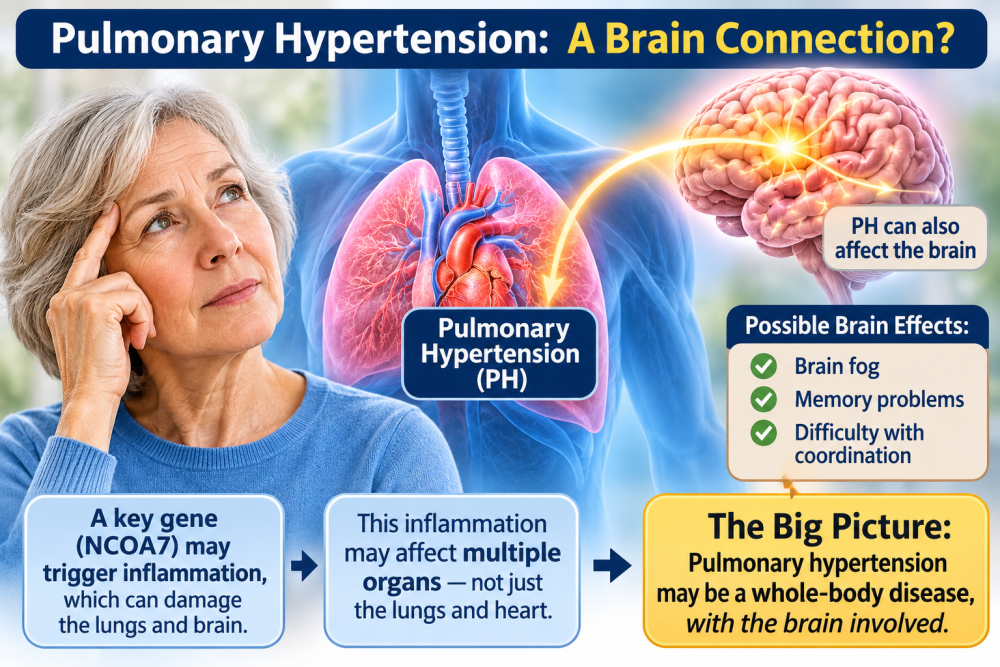
New research uncovers a possible connection between high blood pressure in the lungs, brain inflammation, memory, and coordination.
When we think about high blood pressure, we usually think about the heart, blood vessels, or perhaps the kidneys. But what happens when blood pressure rises in the blood vessels of the lungs? And could this condition affect the brain as well?
New research suggests that the answer may be yes.
A November 2026 study published in the Journal of Clinical Investigation has uncovered a potentially important connection between pulmonary hypertension and changes in the brain. The findings suggest that pulmonary hypertension may be more than a disease of the lungs and heart. It may also affect the brain through inflammatory processes occurring throughout the body.
Pulmonary hypertension (PH) is a condition in which blood pressure becomes abnormally elevated in the arteries carrying blood from the heart to the lungs.
These blood vessels normally allow blood to travel easily through the lungs, where it picks up oxygen. When pressure rises, the heart must work harder to push blood through these narrowed or damaged vessels.
Over time, this extra workload can strain the right side of the heart and potentially lead to heart failure.
Common symptoms include:
Shortness of breath, especially during physical activity
Fatigue and reduced exercise tolerance
Dizziness or lightheadedness
Chest discomfort
Swelling in the legs or ankles
Fainting in more advanced cases
However, researchers are increasingly recognizing that the effects of pulmonary hypertension may extend beyond the heart and lungs.
People with pulmonary hypertension sometimes report difficulty concentrating, memory problems, mental fog, and changes in physical coordination.
These symptoms have often been attributed to reduced oxygen delivery, fatigue, or the overall burden of living with a serious chronic illness.
But researchers from the University of Pittsburgh and their collaborators have identified another possible explanation: inflammation associated with the disease itself may contribute to changes in brain tissue.
In their study, investigators found structural differences in two important brain regions in people with pulmonary hypertension:
1. The Frontal Lobes
The frontal lobes are located toward the front of the brain. They help us:
Concentrate and maintain attention
Plan and organize activities
Make decisions
Solve problems
Control voluntary movements
Changes in these areas could potentially contribute to difficulty concentrating, organizing thoughts, and performing everyday activities.
2. The Cerebellum
The cerebellum is located toward the lower back of the brain. It plays a major role in:
Balance
Coordination
Posture
Smooth and accurate movements
Motor learning
Changes involving the cerebellum could help explain why some patients experience problems with balance, coordination, or movement.
These findings suggest that neurological symptoms in pulmonary hypertension may not simply be a consequence of low oxygen levels. There may be a more direct biological connection.
One of the most interesting aspects of this research involves a gene called NCOA7.
Genes provide instructions that help our cells perform their normal functions. According to the researchers, NCOA7 appears to help control certain inflammatory processes in the body.
The investigators focused on substances called oxysterols. These are modified forms of cholesterol that can participate in important biological processes but may also promote inflammation when their levels or activity become abnormal.
The research suggests that NCOA7 normally helps restrain inflammation associated with these substances.
When this protective mechanism is impaired, inflammatory activity may increase.
To investigate this relationship, the researchers studied specially engineered mice with pulmonary hypertension. Animals lacking functional NCOA7 experienced more severe brain abnormalities, including greater brain tissue damage and loss of brain volume, than animals in which the gene remained intact.
This provides an important clue about how pulmonary hypertension might be connected to brain injury.
It does not yet prove that the same mechanism causes brain damage in every person with pulmonary hypertension, but it gives researchers a specific biological pathway to investigate.
Perhaps one of the most exciting possibilities is that this research could eventually lead to new ways of identifying patients at greater risk of neurological complications.
Researchers are interested in whether:
Genetic testing could identify people with certain NCOA7 variations.
Blood testing for oxysterol levels could help identify increased inflammatory activity.
Brain imaging could detect changes before patients develop noticeable memory or coordination problems.
These approaches are still investigational. They are not currently established screening tests for routine pulmonary hypertension care.
Nevertheless, they could eventually help physicians identify patients who need closer neurological monitoring.
The study raises an important question: Should physicians caring for people with pulmonary hypertension pay closer attention to changes in memory, concentration, balance, and coordination?
The answer is worth serious consideration.
Patients and their families should report new or progressive problems with memory, thinking, balance, or movement to their healthcare providers. These symptoms should not automatically be attributed to aging, fatigue, or pulmonary hypertension itself.
A neurological evaluation may help determine whether another condition is contributing to the symptoms.
Importantly, this research does not establish that the brain changes are reversible, nor does it demonstrate that treating inflammation will prevent neurological complications. Those questions require further investigation.
Perhaps the most important lesson from this research is that the human body cannot always be divided into separate organs and independent diseases.
The lungs, heart, brain, kidneys, blood vessels, and immune system constantly communicate with one another.
A disease that begins in one part of the body can trigger changes elsewhere. Inflammation, circulating chemical substances, changes in blood flow, and genetic factors may all contribute to this process.
For patients with pulmonary hypertension, understanding the possible brain connection may eventually lead to more comprehensive care.
The Bottom Line
Pulmonary hypertension is traditionally viewed as a disease affecting the blood vessels of the lungs and the heart. New research suggests that its effects may extend to the brain, potentially contributing to changes in memory, concentration, balance, and coordination.
The discovery of a possible connection involving the NCOA7 gene and inflammation offers researchers a new direction for investigating these complications.
Pulmonary hypertension may cause ocular changes secondary to reduced cardiac output or impaired oxygenation, including retinal vascular abnormalities, venous congestion, and, rarely, ischemic optic neuropathy. Papilledema is not a typical direct manifestation of PH and warrants investigation for another cause.
Although much more research is needed, one message is clear: When evaluating a disease, we should look beyond the organ where the problem first appears. Sometimes, the effects of disease are much more widespread than we initially realize.
Medical note: This article is for educational purposes and is not a substitute for individual medical evaluation. Anyone experiencing new neurological symptoms should discuss them with a healthcare professional. Sudden weakness, difficulty speaking, severe imbalance, or sudden confusion requires emergency medical attention.
Research reference: Journal of Clinical Investigation, November 2026. DOI/article: https://www.jci.org/articles/view/195110


