

Pickleball-Related Eye Injuries
Pickleball-related eye injuries are on the rise due to the sport’s rapid growth in the United States, especially among adults aged 50 and older
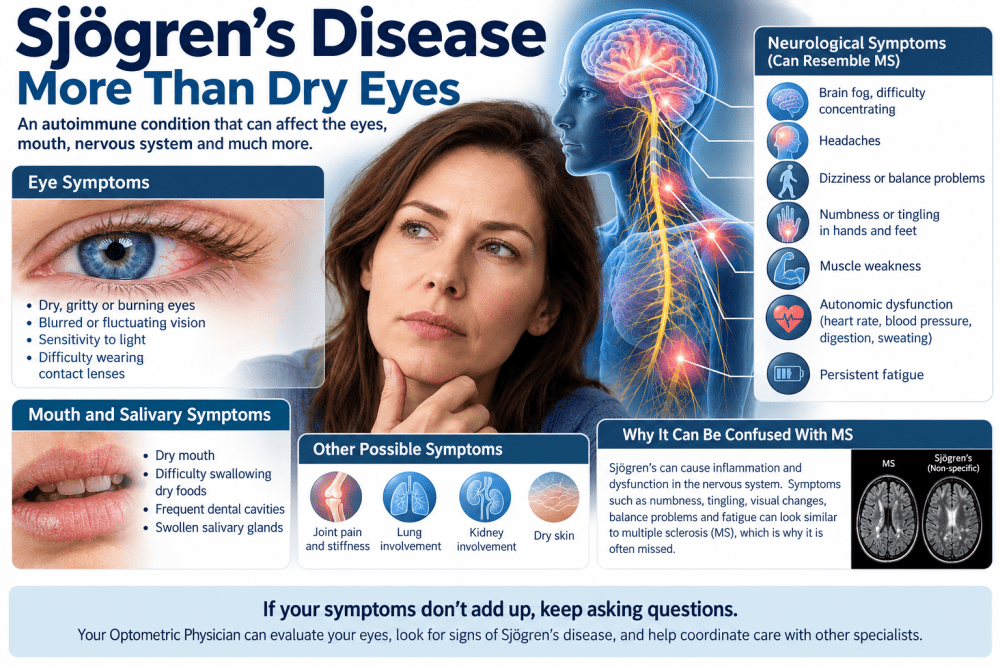
Persistent dry eyes, unexplained fatigue, tingling, dizziness, and brain fog may seem unrelated. But sometimes, these symptoms share a common cause: an autoimmune condition called Sjögren’s disease. Your Optometric Physician may be among the first healthcare professionals to recognize the warning signs.
Imagine visiting your eye doctor because your eyes constantly burn, sting, or feel gritty. You have tried artificial tears, but the discomfort keeps returning.
Meanwhile, you have been experiencing unusual fatigue, occasional dizziness, difficulty concentrating, or tingling in your hands and feet.
Could these symptoms be connected?
The answer is yes.
Sjögren’s disease, also known as Sjögren’s syndrome, is a chronic autoimmune disorder in which the immune system mistakenly attacks the body's own tissues.
It commonly affects the glands responsible for producing tears and saliva, causing dry eyes and dry mouth. However, Sjögren’s is much more than a condition involving dryness.
It can also affect the nervous system, joints, lungs, kidneys, and other organs.
For some patients, neurological symptoms may appear before significant eye or mouth dryness develops.
Multiple sclerosis (MS) is a disease in which the immune system damages structures within the central nervous system, including the brain and spinal cord.
Sjögren’s disease can also produce neurological symptoms, sometimes resembling those associated with MS.
Both conditions may involve:
Numbness or tingling in the arms or legs
Muscle weakness
Problems with balance or coordination
Persistent fatigue
Difficulty concentrating or remembering information
Visual disturbances
Dizziness or other neurological complaints
Some people with Sjögren’s develop inflammation involving the brain or spinal cord. Others experience peripheral neuropathy, which affects nerves outside the brain and spinal cord.
Because symptoms overlap, distinguishing these conditions sometimes requires careful evaluation by several medical specialists.
Importantly, having these symptoms does not mean you have Sjögren’s or MS. Many other medical conditions can produce similar complaints.
One of the most common manifestations of Sjögren’s disease is dry eye disease.
But not all dry eyes are the same.
Some patients experience mild dryness from environmental conditions, medications, prolonged computer use, or age-related changes in tear production.
Others have an underlying inflammatory or autoimmune disorder.
Sjögren’s-associated dry eye often involves reduced tear production, although other types of dry eye may coexist.
Common symptoms include:
Burning, stinging, or gritty sensations
A feeling that something is stuck in the eye
Blurred or fluctuating vision
Sensitivity to light
Redness or irritation
Difficulty wearing contact lenses
Discomfort during reading or computer use
Interestingly, some patients report excessive watering. This may occur because an irritated ocular surface triggers reflex tearing, even when normal tear production is inadequate.
A comprehensive eye examination may reveal abnormalities that suggest Sjögren’s disease.
Your Optometric Physician may perform tests to evaluate tear production, tear stability, and the health of the ocular surface.
These may include:
Schirmer testing: Measures tear production using small strips of paper placed near the lower eyelids.
Tear breakup time: Evaluates how quickly the tear film becomes unstable after blinking.
Ocular surface staining: Uses special dyes to identify damaged or irritated cells on the cornea and conjunctiva.
Meibomian gland evaluation: Examines the oil-producing glands in the eyelids, which help prevent tears from evaporating too quickly.
When examination findings and medical history raise suspicion for Sjögren’s disease, your Optometric Physician may recommend additional medical testing or coordinate care with a rheumatologist.
Sjögren’s can affect different parts of the nervous system.
Peripheral nerves carry information between the brain, spinal cord, and the rest of the body.
When these nerves are affected, patients may experience burning sensations, tingling, numbness, or unusual pain.
Some describe the sensation as walking on hot sand or feeling electrical impulses in their feet.
The autonomic nervous system helps regulate automatic bodily functions, including heart rate, blood pressure, digestion, and sweating.
When affected, symptoms may include dizziness when standing, abnormal sweating, digestive difficulties, or changes in heart rate.
These symptoms can have many causes, so appropriate medical evaluation is essential.
Some patients with Sjögren’s report difficulty concentrating, slowed thinking, memory problems, or overwhelming fatigue.
These symptoms are sometimes described as brain fog.
Fatigue can be particularly frustrating because its severity may not correspond to routine laboratory findings.
Normal routine blood tests do not necessarily exclude Sjögren’s disease.
Less commonly, Sjögren’s may affect the brain or spinal cord, causing neurological findings that can resemble other inflammatory or demyelinating disorders.
In selected patients, additional evaluation may include MRI imaging, neurological examination, and specialized laboratory testing.
There is no single test that establishes or excludes Sjögren’s disease in every patient.
Doctors may request blood tests for certain antibodies, including anti-SSA/Ro and sometimes anti-SSB/La.
However, some patients with Sjögren’s do not have detectable anti-SSA/Ro antibodies.
Diagnosis may involve a combination of medical history, eye testing, salivary gland evaluation, laboratory studies, and sometimes a minor salivary gland biopsy.
A negative antibody test does not automatically rule out the disease.
Untreated ocular surface inflammation and severe tear deficiency can damage the cornea and interfere with comfortable vision.
When Sjögren’s affects other organs or the nervous system, recognizing the condition can also help patients receive appropriate medical evaluation and treatment.
Management may include lubricating eye drops, prescription anti-inflammatory eye medications, tear-conserving treatments, and systemic therapies when medically indicated.
Treatment must be individualized according to the organs involved and the severity of disease.
An Optometric Physician can play an important role in recognizing ocular findings, managing dry eye disease, and coordinating care with other specialists.
Consider discussing possible Sjögren’s disease with your healthcare professional if you have persistent dry eyes or dry mouth accompanied by unexplained fatigue, neurological symptoms, joint discomfort, or recurrent salivary gland swelling.
New or worsening neurological symptoms deserve medical assessment, even when dry eye symptoms are absent.
Sudden vision loss, new severe weakness, difficulty speaking, or sudden problems with walking require emergency medical attention rather than a routine eye appointment.
Please complete this questionnaire before your next visit with your Optometric Physician.
This questionnaire is intended to identify symptoms that may warrant further evaluation. It is not a diagnostic test and cannot determine whether you have Sjögren’s disease, multiple sclerosis, or another medical condition.
Do your eyes frequently feel dry, gritty, burning, or irritated?
☐ Yes ☐ No
Do you use artificial tears regularly to relieve discomfort?
☐ Yes ☐ No
Does your vision fluctuate or become blurry during reading or computer use?
☐ Yes ☐ No
Are your eyes unusually sensitive to light?
☐ Yes ☐ No
Does your mouth frequently feel dry, even when you drink adequate fluids?
☐ Yes ☐ No
Do you need water to swallow dry foods, such as crackers or bread?
☐ Yes ☐ No
Have you experienced recurrent swelling near your cheeks or jaw, or unusually frequent dental cavities?
☐ Yes ☐ No
Do you experience unexplained tingling, burning, or numbness in your hands or feet?
☐ Yes ☐ No
Do you frequently become dizzy or lightheaded when standing?
☐ Yes ☐ No
Have you experienced unexplained problems with balance or coordination?
☐ Yes ☐ No
Do you frequently experience brain fog, difficulty concentrating, or memory problems?
☐ Yes ☐ No
Do you experience persistent fatigue that is not relieved by adequate rest?
☐ Yes ☐ No
Do you have recurring joint pain, stiffness, or unexplained muscle discomfort?
☐ Yes ☐ No
Have you previously been diagnosed with an autoimmune condition?
☐ Yes ☐ No
Have you experienced persistent symptoms despite being told that routine laboratory tests were normal?
☐ Yes ☐ No
If you answered YES to several questions, particularly those involving eye or mouth dryness together with neurological symptoms or fatigue, consider discussing your responses with your Optometric Physician or primary healthcare professional.
Even one persistent or significant symptom may deserve evaluation.
There is no validated numerical cutoff for this educational questionnaire, and the number of YES answers cannot establish your likelihood of having Sjögren’s disease.
Your Optometric Physician can evaluate the health of your eyes, determine whether additional testing is appropriate, and help coordinate care with other medical specialists.
Your eyes are not isolated from the rest of your body.
Sometimes, symptoms that appear unrelated—dry eyes, fatigue, numbness, dizziness, and difficulty concentrating—may provide important clues to an underlying systemic condition.
If your symptoms persist and you still do not have an explanation, continue asking questions.
An examination with your Optometric Physician may be an important step toward understanding what is happening.
Medical disclaimer: This article is provided for educational purposes and is not intended to replace individualized medical advice, diagnosis, or treatment.


